> ## Documentation Index
> Fetch the complete documentation index at: https://docs.perfai.ai/llms.txt
> Use this file to discover all available pages before exploring further.
# Issues
> The Issues page is your complete list of confirmed security vulnerabilities — triaged by severity, mapped to standards, and ready to action.
 ## What is the Issues page?
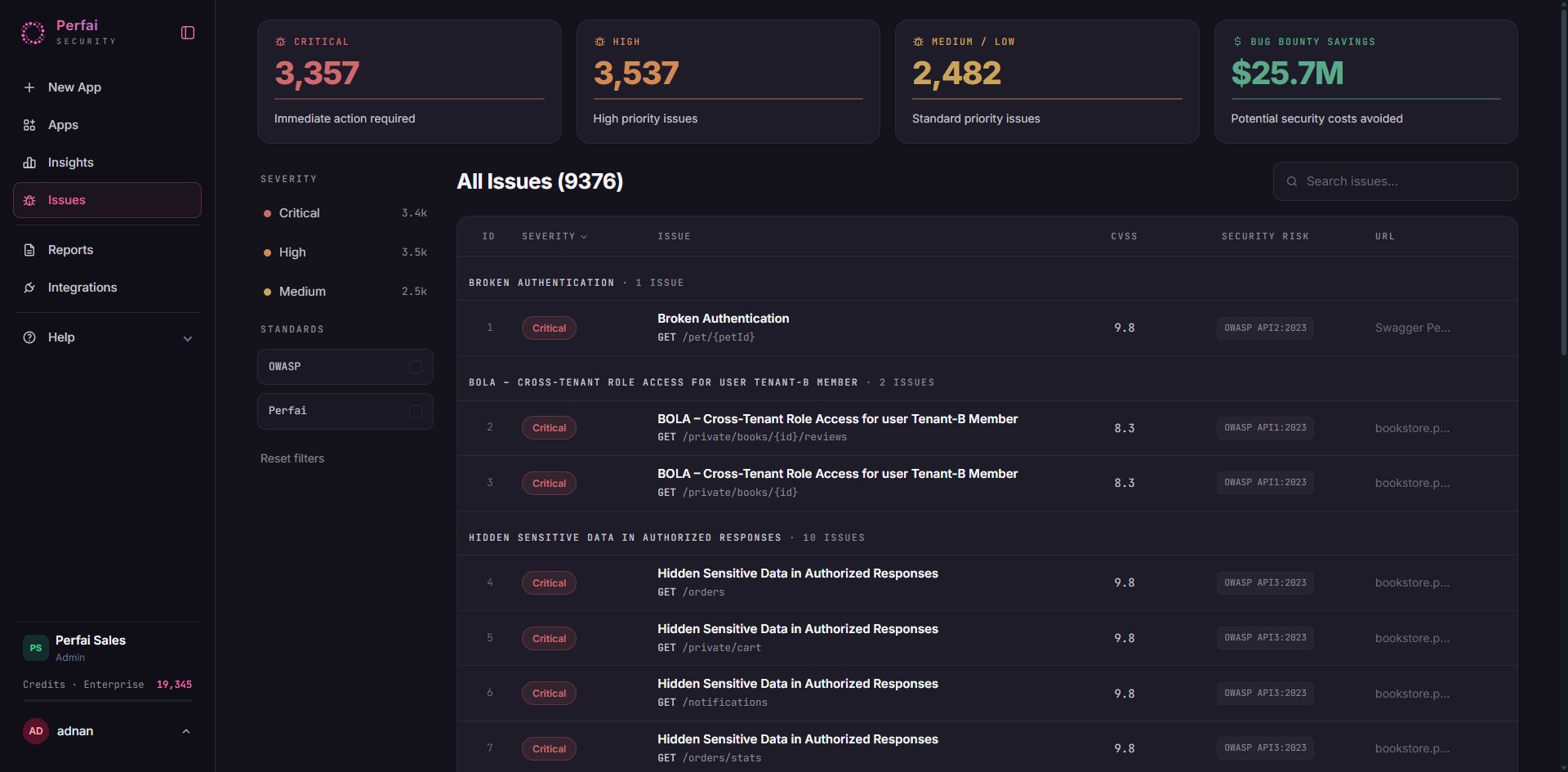
**Issues** is where every confirmed security vulnerability lives. Every finding Perfai surfaces — across all your apps — is collected here, severity-ranked, and mapped to industry standards like OWASP API Security Top 10.
This is the page your security engineers and developers live in. It's where you triage findings, assign fixes, track remediation progress, and understand exactly what's exposed in your apps right now.
***
## The headline numbers
Four metrics at the top give you the current state of your vulnerability backlog:
Confirmed bypasses requiring immediate action — broken authentication, BOLA, privilege escalation with high CVSS scores (9.0+). These are real, reproducible, and actively exploitable.
High-priority issues with clear exploitation paths. CVSS scores typically 7.0–8.9. Should be in your sprint within days of discovery.
Standard priority — real findings with lower immediate impact. Important to address but not at the expense of critical/high work.
Total estimated value of all issues found internally. Every critical finding you fix before a researcher submits it saves real money.
***
## The issue list
The main table shows **All Issues (8,260)** grouped by vulnerability category, ordered by severity:
| Column | Description |
| ------------ | -------------------------------------------------------------------------------- |
| **#** | Issue number within its category group |
| **Issue** | Vulnerability name and the specific API endpoint affected |
| **URL** | The app domain where the issue was found |
| **Type** | The standard the issue maps to (e.g., OWASP API1:2023, OWASP API2:2023) |
| **CVSS** | Common Vulnerability Scoring System score (0–10) — an objective severity ranking |
| **Severity** | Critical / High / Medium / Low badge |
Issues are grouped by category — for example, all **Broken Authentication** findings across different endpoints appear together. This makes it easy to spot systemic problems: 7 endpoints sharing the same auth failure is almost always a middleware issue, not 7 separate bugs.
***
## Vulnerability categories
Endpoints accessible without a valid session. CVSS 9.8 — the highest severity class. Often affects `/private/` routes where auth middleware was missed.
*Example: `GET /private/books/new-releases` returns data without any token.*
Broken Object Level Authorization. User A accesses User B's objects by substituting an ID. CVSS 8.3. The most common critical finding in multi-tenant apps.
*Example: `GET /users/{id}/reviews` returns another user's private reviews.*
A lower-privileged role calls endpoints reserved for higher roles — admin functions accessible to standard users.
Request bodies accept fields that shouldn't be writable — like `is_admin: true` — letting users modify their own permissions.
Batch operations, exports, or admin functions callable by roles that should be excluded, even if individual object access is controlled.
Responses include more data than the requesting role should see — internal IDs, other users' fields, system metadata.
***
## Filtering issues
Use the left sidebar to narrow your focus:
**By Severity:**
* Critical (3.2k)
* High (2.3k)
* Medium (2.8k)
**By Standards:**
* **OWASP API2:2023** — issues mapped to the OWASP API Security Top 10
* **Perfai** — issues found by Perfai's proprietary detection rules beyond standard frameworks
***
## Understanding CVSS scores
Every issue carries a CVSS score so findings are ranked objectively:
| Score | Severity | Common examples |
| ---------- | -------- | ---------------------------------------------------- |
| 9.0 – 10.0 | Critical | Broken Authentication, unauthenticated data access |
| 7.0 – 8.9 | High | BOLA, cross-tenant access, privilege escalation |
| 4.0 – 6.9 | Medium | Partial data exposure, weaker access logic gaps |
| 0.1 – 3.9 | Low | Information disclosure, non-sensitive metadata leaks |
Two Critical findings aren't equal — a 9.8 (unauthenticated access) is more urgent than a 9.1. Always sort by CVSS within a severity band.
***
## Acting on issues
Sort by Severity → Critical, then CVSS descending. A CVSS 9.8 Broken Authentication means data is accessible right now without any credentials.
If a category shows 7+ issues, it's almost certainly systemic — a missing middleware or an incorrect auth check at the service level. Fix the root cause, not each endpoint individually.
Every issue links to full details: the exact endpoint, the role used, the request made, the response received, and a `curl` command to reproduce it. Verify the finding before assigning.
Once a fix is deployed, Perfai re-tests the endpoint on the next scan. If the bypass no longer works, the issue moves to Fixed automatically — no manual update needed.
***
## Per-app Security tab vs. the global Issues page
There are two places to see findings in Perfai — and they serve different purposes:
| | **Per-app Security tab** | **Global Issues page** |
| ----------------- | --------------------------------------------------------------- | ------------------------------------------------------------ |
| **Scope** | One app only | All apps across your portfolio |
| **Best for** | Sprint planning, developer handoff, per-app remediation | Org-wide risk reviews, CISO dashboards, compliance reporting |
| **Extra columns** | CVSS, CWE ID, Savings, Since/Last, run tabs (Coverage, AI Logs) | Grouped by vulnerability category |
| **How to access** | Click an app → **Security** tab | Left sidebar → **Issues** |
The per-app Security tab also shows how each finding maps to a specific role. For example, a BOLA finding is reported once per role that can exploit it — `Ui-Auth-T2 - Admin`, `Ui-Auth-T2 - Member`, `Ui-Auth-T2 - User` — giving you the exact blast radius per role rather than a single collapsed finding.
Use the **AI Logs** tab on the Security page to see exactly how the Security Agent reasoned through each test case — which role it used, what it expected, and what the app actually returned. Invaluable for validating findings before assigning them to a developer.
***
## Exporting for compliance
From the Issues page you can generate reports filtered by app, severity, or standard — suitable for OWASP Top 10 audit evidence, SOC 2 documentation, pen test packages, and engineering sprint planning. See [Reports](/docs/core-concepts/reports).
## What is the Issues page?
**Issues** is where every confirmed security vulnerability lives. Every finding Perfai surfaces — across all your apps — is collected here, severity-ranked, and mapped to industry standards like OWASP API Security Top 10.
This is the page your security engineers and developers live in. It's where you triage findings, assign fixes, track remediation progress, and understand exactly what's exposed in your apps right now.
***
## The headline numbers
Four metrics at the top give you the current state of your vulnerability backlog:
Confirmed bypasses requiring immediate action — broken authentication, BOLA, privilege escalation with high CVSS scores (9.0+). These are real, reproducible, and actively exploitable.
High-priority issues with clear exploitation paths. CVSS scores typically 7.0–8.9. Should be in your sprint within days of discovery.
Standard priority — real findings with lower immediate impact. Important to address but not at the expense of critical/high work.
Total estimated value of all issues found internally. Every critical finding you fix before a researcher submits it saves real money.
***
## The issue list
The main table shows **All Issues (8,260)** grouped by vulnerability category, ordered by severity:
| Column | Description |
| ------------ | -------------------------------------------------------------------------------- |
| **#** | Issue number within its category group |
| **Issue** | Vulnerability name and the specific API endpoint affected |
| **URL** | The app domain where the issue was found |
| **Type** | The standard the issue maps to (e.g., OWASP API1:2023, OWASP API2:2023) |
| **CVSS** | Common Vulnerability Scoring System score (0–10) — an objective severity ranking |
| **Severity** | Critical / High / Medium / Low badge |
Issues are grouped by category — for example, all **Broken Authentication** findings across different endpoints appear together. This makes it easy to spot systemic problems: 7 endpoints sharing the same auth failure is almost always a middleware issue, not 7 separate bugs.
***
## Vulnerability categories
Endpoints accessible without a valid session. CVSS 9.8 — the highest severity class. Often affects `/private/` routes where auth middleware was missed.
*Example: `GET /private/books/new-releases` returns data without any token.*
Broken Object Level Authorization. User A accesses User B's objects by substituting an ID. CVSS 8.3. The most common critical finding in multi-tenant apps.
*Example: `GET /users/{id}/reviews` returns another user's private reviews.*
A lower-privileged role calls endpoints reserved for higher roles — admin functions accessible to standard users.
Request bodies accept fields that shouldn't be writable — like `is_admin: true` — letting users modify their own permissions.
Batch operations, exports, or admin functions callable by roles that should be excluded, even if individual object access is controlled.
Responses include more data than the requesting role should see — internal IDs, other users' fields, system metadata.
***
## Filtering issues
Use the left sidebar to narrow your focus:
**By Severity:**
* Critical (3.2k)
* High (2.3k)
* Medium (2.8k)
**By Standards:**
* **OWASP API2:2023** — issues mapped to the OWASP API Security Top 10
* **Perfai** — issues found by Perfai's proprietary detection rules beyond standard frameworks
***
## Understanding CVSS scores
Every issue carries a CVSS score so findings are ranked objectively:
| Score | Severity | Common examples |
| ---------- | -------- | ---------------------------------------------------- |
| 9.0 – 10.0 | Critical | Broken Authentication, unauthenticated data access |
| 7.0 – 8.9 | High | BOLA, cross-tenant access, privilege escalation |
| 4.0 – 6.9 | Medium | Partial data exposure, weaker access logic gaps |
| 0.1 – 3.9 | Low | Information disclosure, non-sensitive metadata leaks |
Two Critical findings aren't equal — a 9.8 (unauthenticated access) is more urgent than a 9.1. Always sort by CVSS within a severity band.
***
## Acting on issues
Sort by Severity → Critical, then CVSS descending. A CVSS 9.8 Broken Authentication means data is accessible right now without any credentials.
If a category shows 7+ issues, it's almost certainly systemic — a missing middleware or an incorrect auth check at the service level. Fix the root cause, not each endpoint individually.
Every issue links to full details: the exact endpoint, the role used, the request made, the response received, and a `curl` command to reproduce it. Verify the finding before assigning.
Once a fix is deployed, Perfai re-tests the endpoint on the next scan. If the bypass no longer works, the issue moves to Fixed automatically — no manual update needed.
***
## Per-app Security tab vs. the global Issues page
There are two places to see findings in Perfai — and they serve different purposes:
| | **Per-app Security tab** | **Global Issues page** |
| ----------------- | --------------------------------------------------------------- | ------------------------------------------------------------ |
| **Scope** | One app only | All apps across your portfolio |
| **Best for** | Sprint planning, developer handoff, per-app remediation | Org-wide risk reviews, CISO dashboards, compliance reporting |
| **Extra columns** | CVSS, CWE ID, Savings, Since/Last, run tabs (Coverage, AI Logs) | Grouped by vulnerability category |
| **How to access** | Click an app → **Security** tab | Left sidebar → **Issues** |
The per-app Security tab also shows how each finding maps to a specific role. For example, a BOLA finding is reported once per role that can exploit it — `Ui-Auth-T2 - Admin`, `Ui-Auth-T2 - Member`, `Ui-Auth-T2 - User` — giving you the exact blast radius per role rather than a single collapsed finding.
Use the **AI Logs** tab on the Security page to see exactly how the Security Agent reasoned through each test case — which role it used, what it expected, and what the app actually returned. Invaluable for validating findings before assigning them to a developer.
***
## Exporting for compliance
From the Issues page you can generate reports filtered by app, severity, or standard — suitable for OWASP Top 10 audit evidence, SOC 2 documentation, pen test packages, and engineering sprint planning. See [Reports](/docs/core-concepts/reports).