

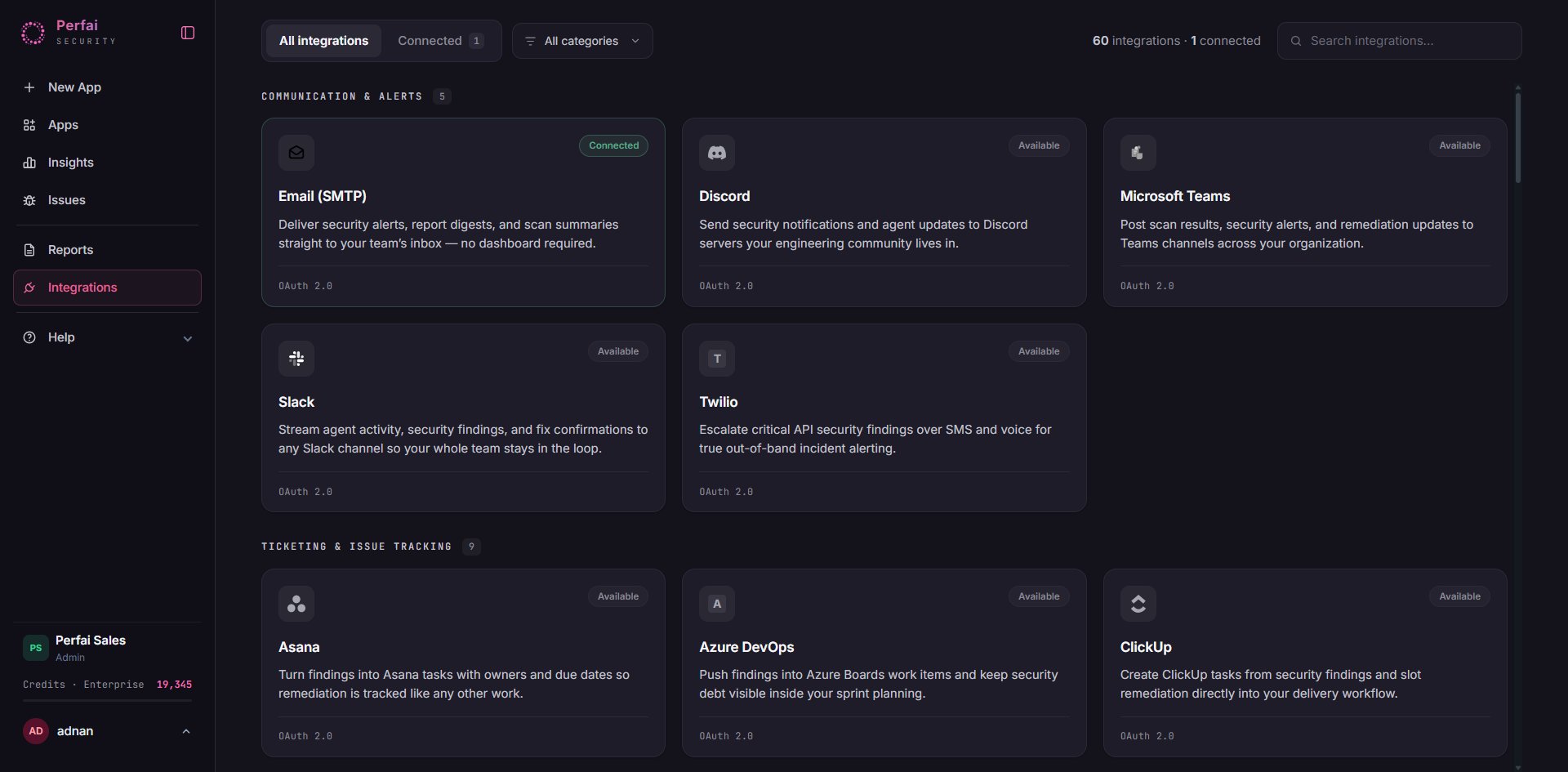
What is the Integrations page?
Integrations connects Perfai to the tools your engineering and security teams already live in. Instead of requiring everyone to log into another dashboard, Perfai pushes findings, alerts, and reports directly to Slack, GitHub, Jira, and wherever your team works. The integrations page is organized into four categories: Communication, Storage, Issue Tracking, and SIEM.Communication
Agent scan start & completion alerts
Know the moment a scan begins and when results are ready — no need to check the dashboard.
Instant critical vulnerability notifications
Critical findings are surfaced immediately, not buried in an email digest.
Fix Agent PR confirmations
When the Fix Agent opens a PR (e.g., PR #247: Sanitize user ID param in /users/), your team sees it the moment it lands.
Weekly security score digest
A regular summary of your portfolio’s security posture — findings opened, fixed, and trending.
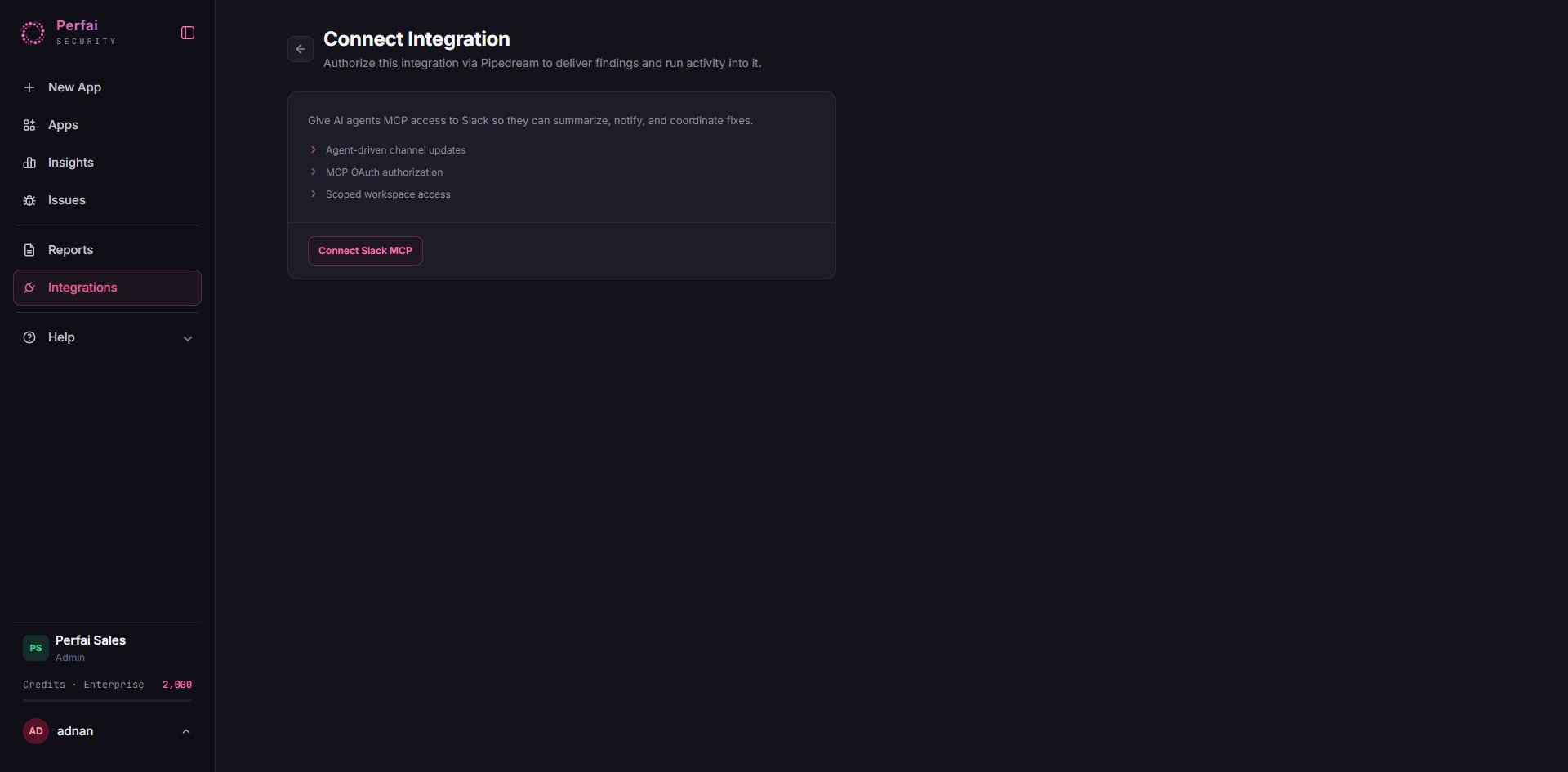
Slack
Post to any channel · workspace. Best for engineering teams who live in Slack.
Discord
Post to any server channel. Best for engineering communities and teams who coordinate in Discord.
Send alerts to your inbox. Best for executive recipients, auditors, and on-call rotations.
Storage
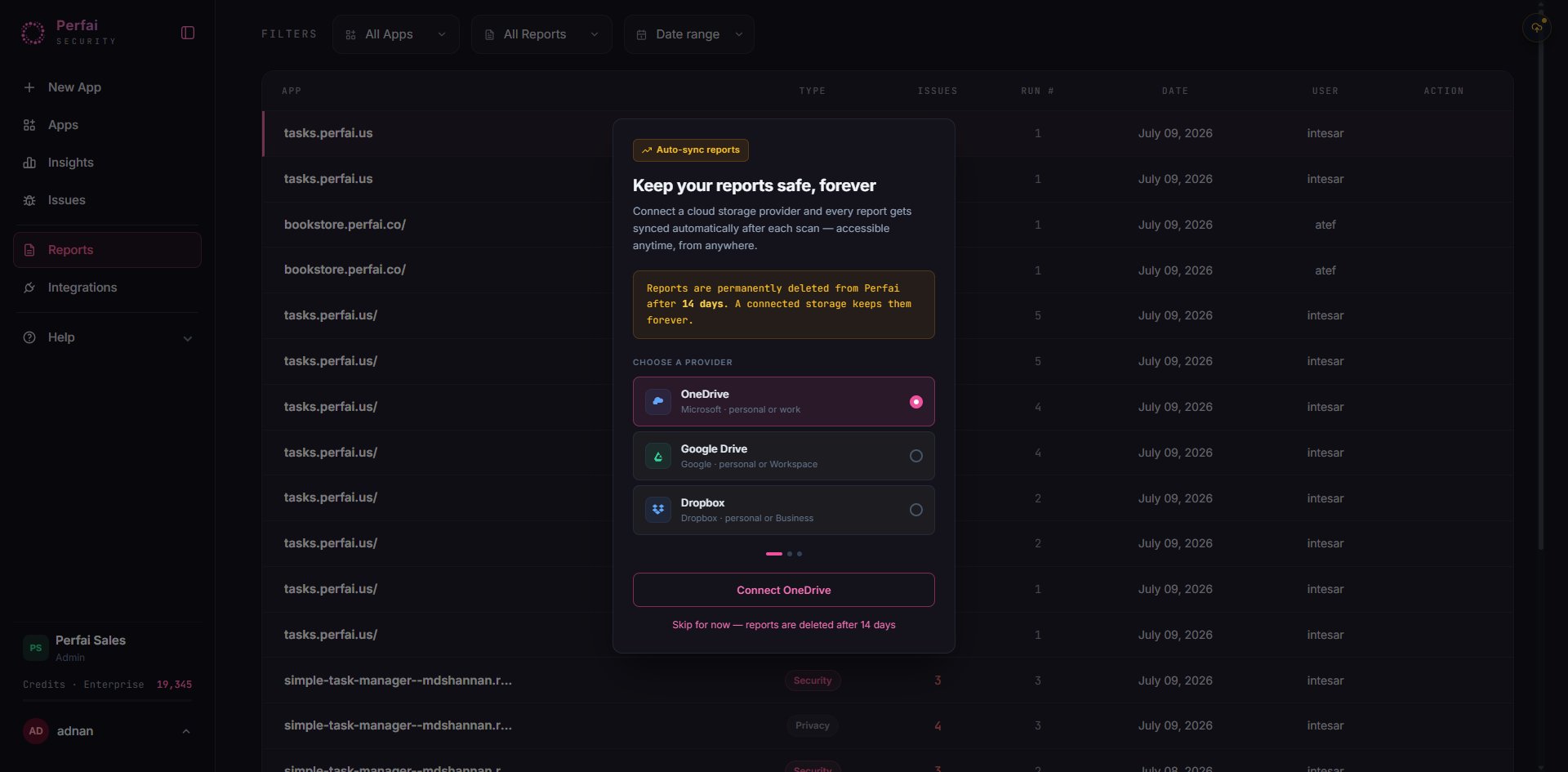
Google Drive
Connected — Automatically save security and privacy reports to a designated Drive folder. Share with stakeholders who don’t have Perfai access.
Dropbox
Available — Sync reports and findings exports to Dropbox for enhanced file management and team collaboration.
OneDrive
Available — Save and share reports within your Microsoft 365 environment via OneDrive.
Storage integrations are especially useful for compliance workflows — automatically depositing a fresh security report after every scan means your audit evidence is always up to date and accessible without manual effort.
Issue Tracking
- A new vulnerability is found → Perfai opens a ticket automatically
- The developer fixes it → Perfai re-tests on the next scan
- The fix passes → Perfai closes the ticket automatically
- Issues opened on each vuln, with full exploit context
- Auto-closed when retest passes
- Zero manual issue hygiene required
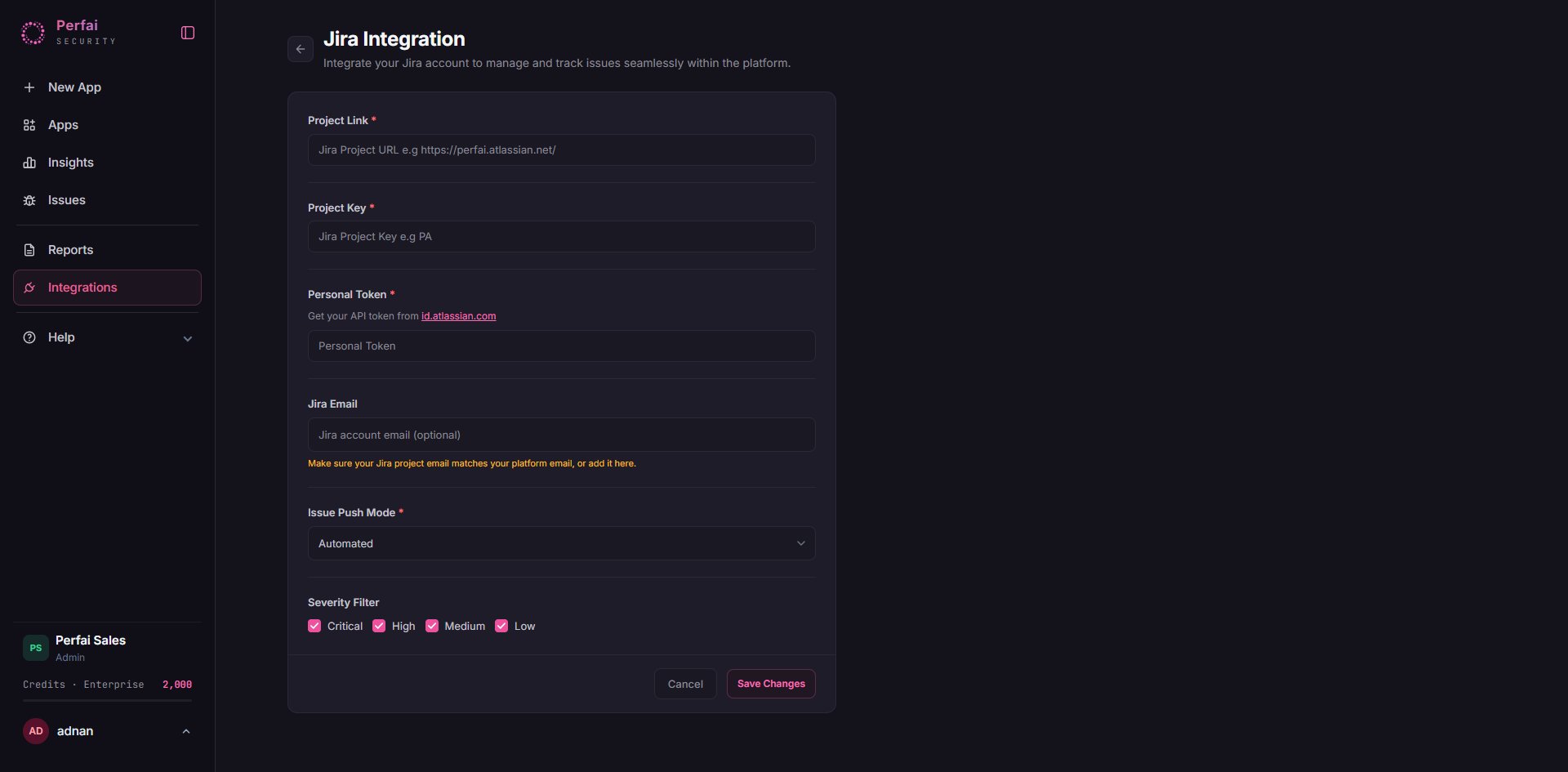
Jira
Cloud · Server · Data Center. Best for teams using Jira for sprint planning and backlog management.
GitHub Issues
Repository · organization. Best for engineering teams whose work lives alongside the codebase.
GitHub MCP
Available — Connect GitHub via the Model Context Protocol for deeper automation alongside your existing tooling.
Linear MCP
Available — Connect Linear via MCP to manage security issues alongside your product roadmap in Linear.
Monday.com
Available — Create an item on a chosen board for each validated finding, so security work sits alongside the rest of your team’s tasks.
HackerOne
Available — File validated findings as structured HackerOne reports — with title, severity, and full vulnerability details — into the program you run.
SIEM
Perfai publishes every security finding through a single, standards-based feed that any SIEM can pull — there’s no per-tool integration to build. Your SIEM polls one endpoint on a schedule and ingests findings as they’re opened, updated, and resolved. Because the feed is a standard HTTP/JSON endpoint, it works with any SIEM that can poll a REST source — including Splunk, Microsoft Sentinel, Elastic, IBM QRadar, and Sumo Logic.One endpoint, any SIEM
Formats
The same endpoint serves two formats — pick the one your SIEM ingests best with theformat parameter:
OCSF (default)
Open Cybersecurity Schema Framework — each finding is an OCSF Vulnerability Finding. JSON-native and normalized, so modern SIEMs map fields automatically.
CEF
Common Event Format — a compatibility fallback for tools that expect CEF-style events.
Parameters
Each response includes a
next_cursor value — pass it back as since on the next request so you only ever pull what’s changed.
How to connect it
1
Get your organization API key
Generate a feed API key for your organization. This key both authenticates the feed and scopes it to your data.
2
Add an HTTP poller in your SIEM
Create a scheduled REST/HTTP polling input pointing at
https://<your-perfai-host>/v1/siem/findings. This is the same input type every major SIEM ships with — a Splunk REST input, a Sentinel Logic App, an Elastic Agent HTTP JSON input, a QRadar Universal REST source, or a Sumo Logic scheduled collector.3
Set the authorization header
Add
Authorization: Bearer <your-org-api-key> to the request headers.4
Choose a format and schedule
Append
?format=ocsf (or ?format=cef) and set a polling interval — every 5 minutes is typical. Store the returned next_cursor and send it as since on each subsequent poll for incremental delivery.One feed covers every SIEM. You don’t need a Perfai-built connector for your specific platform — if your tool can poll an authenticated HTTP endpoint, it can consume the feed.
Why integrations matter
Security tools fail when they create silos. If developers have to log into a separate platform to see security findings, they won’t — and vulnerabilities stay open longer. Perfai’s integrations put findings where your team already is:- A Slack alert the moment a Critical finding is confirmed means your team responds in minutes, not days
- A GitHub Issue created automatically from a BOLA finding means it’s already in the sprint backlog with full reproduction details — no translation needed
- A Google Drive report deposited after every scan means your compliance folder is always current without manual exports
Connecting an integration
1
Click the integration card
Each card shows its current status — Connected (green) or Available (grey). Click an Available card to begin the connection flow.
2
Authorize access
Most integrations use OAuth — you’ll be redirected to the provider (Slack, GitHub, Google, etc.) to authorize Perfai’s access. No API keys to manage manually.
3
Configure the destination
After connecting, configure where Perfai sends data — which Slack channel, which GitHub repo, which Jira project, which Drive folder.
4
Test it
Trigger a manual scan on any app and confirm findings appear in the connected tool. Most integrations push within seconds of a finding being confirmed.